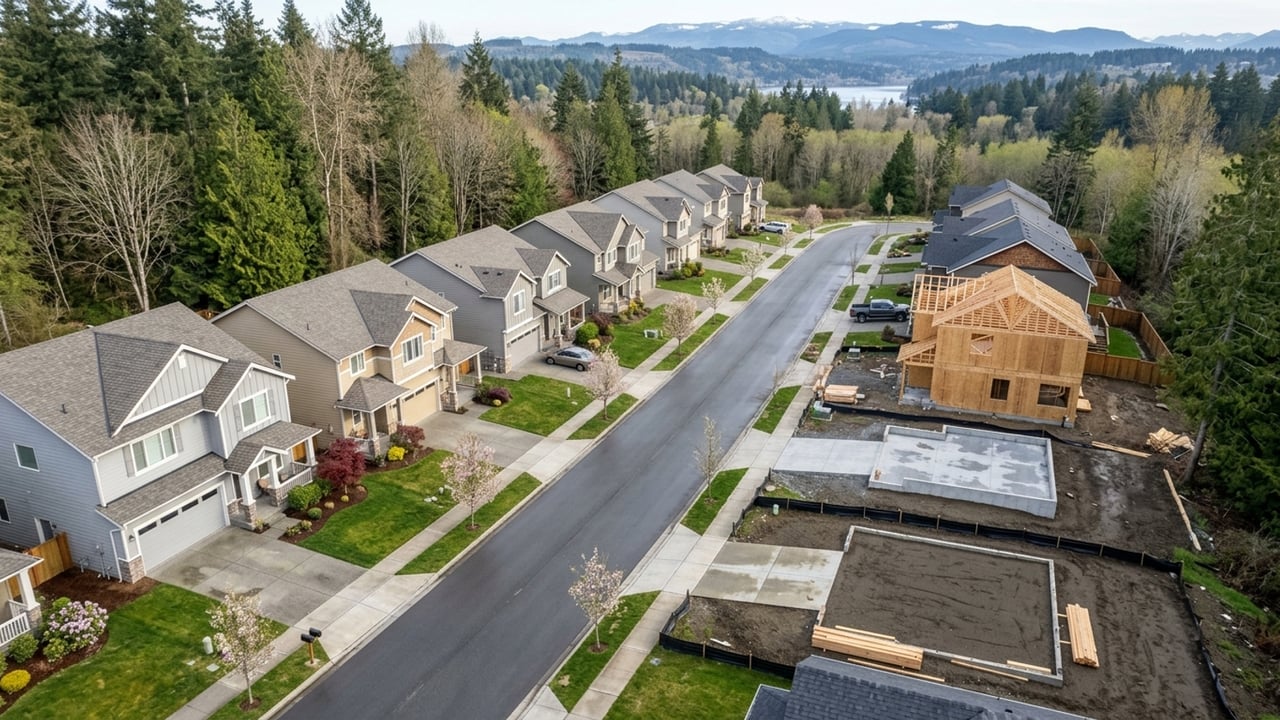
A typical single-family house in Lake Stevens, WA, sells for around $717,214. When buyers see that figure, plenty of them wonder whether buying a vacant parcel and hiring a builder would get them a better house for less money.
The reality is more complicated. Custom construction means managing land costs, utility connections, and municipal fees before a foundation is even poured. You get control over the floor plan and finishes, but you need upfront cash and a genuine tolerance for timelines that move.
Key Takeaway
Building your own home in Lake Stevens only saves money if your all-in cost, including the lot, site work, utility hookups, permits, impact fees, and construction, comes in under the median price existing single-family homes recently sold for with the land included. Build when you want a house the resale market is not offering, or when you already own the lot. Buy resale when total cost and move-in timing matter most.
Who This Guide Is For
You are weighing whether to buy a lot (or use land you already own) and build a house in the Lake Stevens area, and you need to know whether it pencils out against buying an existing home and what has to happen first.
Is It Cheaper to Build or Buy a House in Lake Stevens?
In Lake Stevens, an existing single-family house sells for a median $361 per square foot with the land already included. Building only saves money if your lot, site work, utility hookups, permits, impact fees, and construction together come in under that line.
That financial reality makes building a way to get the exact house a tight resale market will not give you, rather than a shortcut to a cheaper property. A direct comparison weighs the total cost of a finished build against the baseline of current neighborhood values.
What an existing house costs per square foot
A 2,000-square-foot house at that median is about $722,000, which sits close to the single-family median sale price. That is roughly what a typical resale costs with the land included, and it is the number a build must beat. You can check recent housing market statistics to see how prices trend in different neighborhoods.
The median blends older ramblers, newer subdivisions, and lakefront homes, so it is an imperfect benchmark. The resale price for the type and location you would build may sit well above or below the median. Price comparable homes near your lot before trusting that number.
What your build has to add up to
A custom build stacks multiple expenses before framing begins: the lot price, site work such as clearing and drainage, utility connections or septic installation, permits, plan review, and impact fees. Once you are building vertically, add the construction quote, Washington sales tax on construction, construction-loan interest, and your own housing costs during the build.
Local fees add up quickly. Under Snohomish County Code 30.66C.100, the school impact mitigation fee for Lake Stevens School District No. 4 is $13,730 per single-family dwelling unit, applicable to developments vesting from January 1, 2025, through December 31, 2026. The City of Lake Stevens lists the same figure for a detached single-family residence. You can review local schools to see how the district operates.
Builder bids rarely include site surprises such as rock, poor drainage, or a long utility run. Change orders during the build push the total past the benchmark faster than any single line item. Cost certainty is the thing you give up.
When building still makes sense
Detached resale homes turn over with little negotiating room: 32.8% of single-family homes recently sold above list price and supply sits at just 2.8 months. A build gets you a floor plan, lot, or energy performance the existing inventory is not offering. Resale means competing; building swaps that competition for a schedule.
Owning land already changes the math entirely. The land is the cost a resale price already includes, so owning it is where building most often beats buying. The catch is that you trade bidding wars for months of permitting and construction, you may carry two housing costs simultaneously, and you face a final price you will not know until the house is done.
Finding a Buildable Lot in Lake Stevens
Land is the cost resale prices hide. The parcel you choose dictates the permit office, the utility costs, and the buildable footprint. A cheap lot can become expensive fast if it requires a long sewer extension or extensive environmental studies.
Renee Pilchard can pull recent vacant-land sales for a lot you are considering. Comparable land sales give you a negotiating baseline before you enter the feasibility period.
City limits or unincorporated Snohomish County
Having "Lake Stevens" in your mailing address does not mean the City of Lake Stevens issues your building permit. Look up the parcel through Snohomish County's parcel lookup and the city limits map to confirm the jurisdiction.
The city and the county have different permit processes and fee schedules, which affects your budget and timeline. You can compare the best neighborhoods in Lake Stevens or areas in West Lake Stevens to see how boundaries affect local amenities. If you guess wrong, you budget against the wrong fee schedule and review timeline. Confirm jurisdiction in writing during the feasibility period.
Sewer, septic and water
Lots with sewer at the street pay a connection or capacity charge to the sewer district. Lots without sewer need a soil evaluation and a septic design approved by the county health department. Water service comes from the PUD or a private well. Get a sewer availability letter or a soil evaluation before closing.
For 2025-2026, the Snohomish County Health Department's optional Soil Survey service carries an $830 base fee plus a per-lot/per-acre fee. The standard application-review fee for a new gravity or pressure on-site sewage system is listed around $1,130, plus a $385 installation permit fee. You can review standard monthly utility costs to budget for bills after move-in.
Skip these checks and you lose certainty. A failed soil evaluation or a long sewer extension can make a bargain lot unbuildable, or more expensive than a serviced one. That is why the feasibility contingency matters more than the asking price.
Lakefront lots, wetlands and steep slopes
Shoreline setbacks and critical-area buffers shrink the buildable footprint and can require reports before a permit is issued. Under the Lake Stevens Shoreline Master Program, the required shoreline buffer is 50 feet from the lake's ordinary high-water mark, plus an additional 10-foot building setback, for a combined standard of 60 feet. On Waterfront Residential parcels separated from the lake by a road, the rear upland setback is reduced to 20 feet.
Lakefront buyers should read the shoreline rules before pricing a house size. You can review lakefront ownership details to understand dock and water rights. Order a survey and title review to find easements and setbacks before design begins.
A lot's listed acreage can overstate what you can build on. Buffers and required studies add cost and time before design even starts.
Permits and Impact Fees in Lake Stevens
The jurisdiction your lot falls in determines your upfront government costs and timelines. The City of Lake Stevens Permit Center handles properties inside city limits; Snohomish County Planning and Development Services handles unincorporated areas.
These fees apply before you break ground, and they are typically paid in cash rather than financed through your construction loan. Checking current fee schedules before you commit prevents budget shortfalls that are hard to recover from mid-build.
Building permits and plan review
Per the City of Lake Stevens' 2026 Fee Resolution, building permit fees for single-family residences are calculated based on construction valuation. Fees for plan review and inspections are comprehensive, covering two correction cycles, with any additional review or inspections billed at an hourly rate.
Snohomish County PDS Assistance Bulletin #18 bases residential building permit and plan check fees on the county's valuation of the structure. Example unit valuations are $175.92 per square foot for the first, second, and third floors of a new residence, $31.50 per square foot for an unfinished basement, and $71.07 per square foot for a garage. The bulletin notes added fees including a $6.50 Washington State Surcharge and a $320 Site Review Fee, and states that review times for applications filed during spring and summer months are typically longer.
Review clocks pause while you answer correction requests, so incomplete plans cost weeks. Ask the permit office for current review times when you apply, not when you buy the lot, because carrying costs on the land keep running while you wait.
Impact fees
Traffic and park impact fees apply alongside the school impact fee described above. For the City of Lake Stevens, the 2026 single-family Park Mitigation Fee is $4,572. Effective July 1, 2026, the City's Traffic Mitigation Fee is $5,659 for Traffic Impact Zone 1 and $3,725 for Traffic Impact Zones 2 and 3.
Snohomish County itself does not levy separate park or traffic impact fees inside incorporated Lake Stevens. County transportation review fees apply only to unincorporated county development, such as a $2,300 fee for an administrative site plan for single-family detached units.
Fee schedules change, often yearly, and the amount due is the one in force when your permit is issued, not when you bought the lot. Budget accordingly.
How to Build a House in Lake Stevens Step by Step
Following a specific sequence protects your money and keeps you from committing funds before the lot and the builder are fully vetted. Rushing into a land purchase without financing lined up can leave you holding a property you cannot afford to develop.
The standard process moves through securing money, verifying the land, hiring professionals, and passing municipal inspections. Each phase requires specific contracts and contingencies.
Step 1: Get preapproved for a construction loan
Construction-to-permanent loans pay builders in draws and convert to a mortgage at completion. Know your lender's down payment, land-equity, and reserve requirements before shopping for land, and get the builder-approval requirements in writing.
If you are funding the build by selling a current property, review the steps for selling your home to time the transition. Coordinating a sale with a build usually requires temporary housing or a long rent-back agreement. Interest accrues on each draw during construction, and some lenders require an approved builder and plans before final approval, which can stall owner-builders at an inconvenient moment.
Step 2: Buy the lot with a feasibility period
Write the offer with time to confirm jurisdiction, sewer or septic availability, buffers, a survey, easements, and any HOA rules. Read the CC&Rs for rules on builders, design approval, or minimum house size. Remove the feasibility contingency only once each item checks out.
Sellers of desirable lots may resist long feasibility periods. Budget for soil and survey costs you could lose if the lot fails your tests, and treat that as the cost of not buying a problem.
Step 3: Choose a builder or act as your own contractor
Washington's contractor registration law exempts any person working on their own property from the requirement to register as a contractor. Under RCW 18.27.090(12), this exemption applies whether the property is occupied by the owner or not, but it does not apply if the owner is performing the work for the purpose of selling, demolishing, or leasing the property.
Verify any builder's registration, bond, and insurance using Washington L&I's contractor lookup. Get fixed-price versus cost-plus terms in writing before signing a contract. Acting as your own contractor can save the builder's margin, but you carry the scheduling, the subcontractor risk, and lender skepticism. Many construction lenders will not fund owner-builders.
Step 4: Design, permit, build and move in
Plans go to the permit office, construction proceeds through required inspections to final approval and occupancy, and the loan converts. Ask the builder how the plans meet the current Washington State Energy Code to confirm compliance.
Lake Stevens experiences a distinct wet season that affects site work. Review local weather patterns to understand how rain impacts excavation and concrete pouring. Rain-season delays, failed inspections, and backordered materials all extend the schedule, and every added month means more loan interest and housing costs stacked against the resale comparison you started with.
How to Decide Between Building and Buying
Do you already own the lot? If yes, the biggest cost that resale prices bake in is already paid. Start with builder bids and the permit and impact-fee section above.
Is the lot inside Lake Stevens city limits or in unincorporated Snohomish County? Check the parcel first, because the answer changes the permit office and the fees. Is sewer available at the street, or will the lot need a septic system? Start with a soil evaluation during your feasibility period if you are looking at a lower-priced lot without sewer.
Can you carry your current housing cost through permitting and construction? If not, start with resale single-family listings. If you want to be in a house within months rather than after a build, resale is the straightforward answer. Start with the shoreline setback rules and the lakeside buying guide if a lakefront build is the goal. Pilchard Properties can price comparable resale homes and vacant land for a specific lot to help you make the final call.
Lake Stevens Housing Market at a Glance
The figures below cover the 90 days ending September 30, 2026, and show the resale baseline a custom build must come in under:
- Single-family median sale price: $717,214, up 1% year over year (133 sales, 90 days ending 2026-09-30)
- Single-family median price per square foot: $361 (90 days ending 2026-09-30)
- Single-family median days on market: 18 (90 days ending 2026-09-30)
- Single-family sale-to-list ratio: 100%; 32.8% sold above list price (90 days ending 2026-09-30)
- Single-family months of supply: 2.8, with 123 homes in inventory (90 days ending 2026-09-30)
- All homes median sale price: $674,679, down 2.2% year over year (155 sales, 90 days ending 2026-09-30)
- All homes median price per square foot: same as single-family; 3 months of supply (90 days ending 2026-09-30)
Building a Home in Lake Stevens FAQs
What county is Lake Stevens, WA, in?
Lake Stevens is in Snohomish County. Lots outside city limits are permitted by Snohomish County Planning and Development Services, which bases residential building permit and plan check fees on the county's valuation of the structure. Confirm which office applies by checking the parcel lookup before budgeting permit costs.
Does Lake Stevens, WA, flood?
It depends on the parcel. Lake Stevens has mapped flood hazard areas on its FEMA Flood Insurance Rate Map, including Special Flood Hazard Area Zone A (the 1% annual chance floodplain) and Zone X (the 500-year floodplain) along Lake Stevens and associated drainages. Snohomish County's current Digital FIRMs were adopted countywide in June 2020. Check the FEMA flood map for the parcel and get a flood insurance quote before buying land.
Do I pay sales tax on building a new house in Washington?
Yes, retail sales tax applies to new home construction and custom builds in Washington. The builder collects the tax, and the local rate depends on the location of the build. Ask your builder whether quotes include sales tax.
Can I live in an RV on my lot while my house is being built in Lake Stevens?
Within Lake Stevens city limits, a recreational vehicle may not be used as a permanent residence. If an RV is used as a temporary residence while a house is under construction, it must comply with the Temporary Use standards, and the City's fee schedule lists a $240 'Temporary Residence' permit fee. Unincorporated county land follows separate Snohomish County rules, so confirm with the permit office and the HOA if one applies.
How is a newly built home assessed for property tax in Snohomish County?
For Snohomish County property tax purposes, new construction value is captured on a partial-year basis. The assessment date for new construction is July 31 of each year for taxes collected the following year. This is distinct from the January 1 valuation date used for existing property.
Can I build an ADU on my lot in Lake Stevens?
Yes, Lake Stevens allows up to two accessory dwelling units (ADUs), attached or detached, per lot with a principal unit in residential zoning districts. ADUs must have a gross floor area between 250 and 1,000 square feet, be on a foundation per the current International Residential Code, and require one off-street parking space unless within a half-mile walking distance of a major transit stop. Only one short-term rental is permitted per parcel, in either the primary dwelling or an ADU, but not both. Confirm with the county if your lot sits in unincorporated Snohomish County.
Sources
- Redfin: Data Center
- Snohomish County: SCC 30.66C.100
- City of Lake Stevens: Civic Alerts
- City of Lake Stevens: 2026 Fee Resolution
- Snohomish County: Residential Building Permits Bulletin
- Snohomish County Health Department: Fee Adjustment Comparison
- City of Lake Stevens: Shoreline Master Program
- Washington State: RCW 18.27.090
- Snohomish County: DFIRM Floodplain Maps
- City of Lake Stevens: RV Regulations
- Snohomish County: Assessor Newsflash
- City of Lake Stevens: ADU Checklist