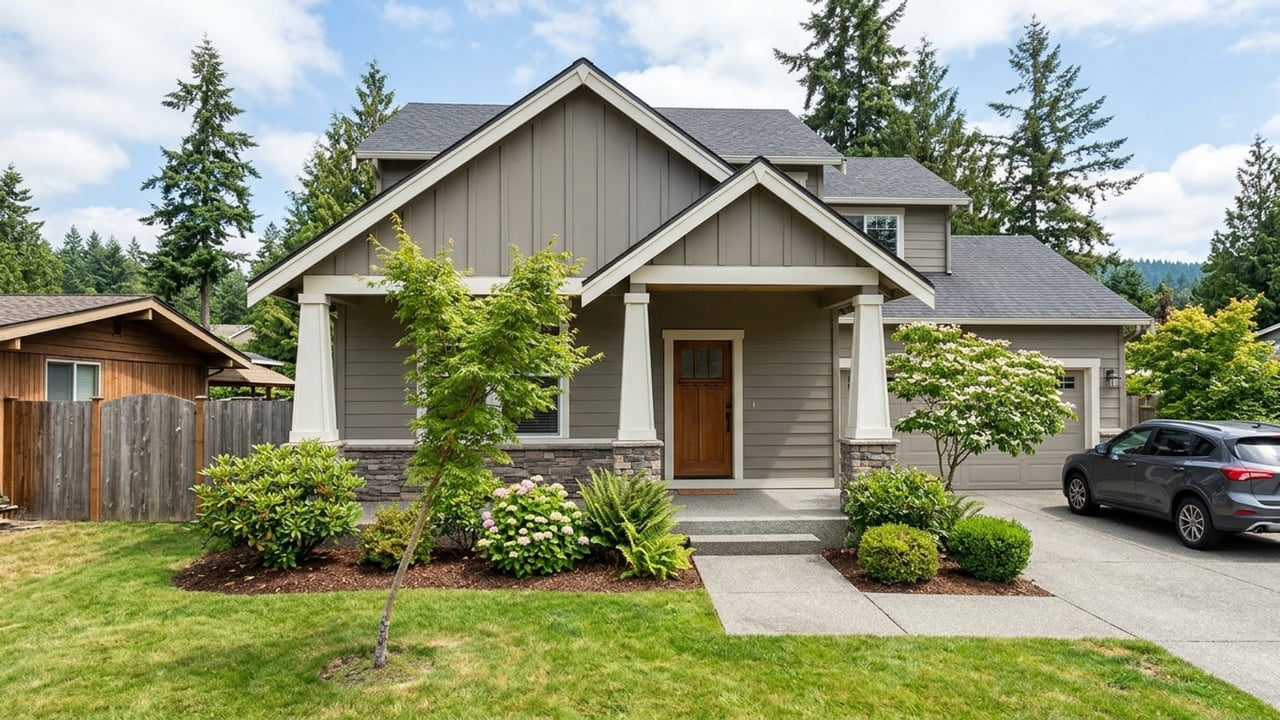
Lake Stevens' population growth lands almost entirely on detached houses.
Key Takeaway
Lake Stevens has about 42,590 residents according to the state's official April 1, 2026 estimate. That growth shows up mostly as demand for detached houses, which made up 133 of the 155 homes sold in the 90 days ending September 30, 2026. If you're planning to buy a house, you'll need to move quickly once something hits the market. If you have more flexibility, the small condo market runs at a noticeably slower pace.
Who This Guide Is For
You're checking how big Lake Stevens is and how fast it's growing because you're deciding if and how to buy or sell a home here.
Lake Stevens, WA Population Counts and Estimates
The Washington State Office of Financial Management (OFM) estimates the Lake Stevens, WA population at 42,590 as of April 1, 2026. The 2020 decennial Census counted 35,630 residents within the city limits.
The two sources measure differently. The federal Census conducts a hard count once every ten years. OFM releases its own estimates every April 1 and publishes them around June. Any website showing a 2026 population before OFM's summer release is running its own model, so confirm the newest OFM release before relying on a quoted figure for the city.
City Growth and Annexation History
The city grew from 28,069 in the 2010 Census to that 2020 count. Much of the jump came from redrawing city boundaries rather than new arrivals building homes. Lake Stevens expanded largely through its "One Community Around the Lake" annexation program.
Major annexations certified by the OFM include Northlake and Frontier Village in 2006, which added roughly 5,900 residents combined. A large southwest annexation took effect in late 2009, bringing in approximately 10,874 more people. The city also completed a southeast interlocal annexation in 2021, pulling the lake itself and surrounding properties into the city limits.
By 2024, the city covered about 7,550 acres, with roughly 500 acres remaining in its Urban Growth Area. Planned future growth means more subdivisions and infill construction near existing neighborhoods. Ask the City of Lake Stevens planning department for approved plats or pending subdivisions near any address you're considering. Growth also shapes daily commutes, school enrollment boundaries and the local job market, so check those alongside the population numbers.
How Population Growth Impacts the Local Housing Market
Because that demand falls on detached houses, a house hunter faces a tighter market than someone open to an attached unit. If you can't act within a couple of weeks of a listing going live, weigh the condo comparison below before assuming a house is your only option. If you're selling a house or a condo, the selling section explains why the blended median's recent dip doesn't describe house values.
If you're buying a home
Growth pressure turns a house hunt into a speed contest. Single-family homes had just 2.8 months of supply in the 90 days ending September 30, 2026, so the available inventory would empty in under three months if no new listings arrived. About one in three Lake Stevens homes sold for more than the asking price in that window. Before you start touring, get your financing approved and settle how you'll make a decision.
Condos move more slowly, with a median of 32 days on market, but the pool is thin: only 10 sold in that window. The 33.1% year-over-year drop in the condo median (based on 10 condo sales) reflects which units happened to sell rather than any market-wide price collapse. Before you compare a condo to a house, ask the HOA for current dues, what they cover, and the reserve-study status.
If you're selling a home
For house sellers, growth-driven demand translates to speed. The median single-family house sold in 18 days at 100% of list price over the 90 days ending September 30, 2026. Price it right and it should move within weeks.
The 2.2% drop in the all-homes median is a mix effect. Single-family prices rose 1% year over year, so the blended headline doesn't describe what's happening to house values.
Pushing for a higher price costs you certainty. A 100% sale-to-list ratio means houses sell at asking price on balance, not over it. Most homes still sell at or below list, so growth doesn't guarantee a bidding war, and pricing above recent comparable sales tends to lengthen time on market. Pilchard Properties can pull recent sales for a specific street if you need detailed numbers.
Related guides: Where Is.
At a Glance
- All homes, median sale price: $674,679, down 2.2% year over year (90 days ending 2026-09-30)
- All homes, homes sold: 155; inventory: 154; months of supply: 3 (90 days ending 2026-09-30)
- All homes, median days on market: 20; sale-to-list: 100.1%; sold above list: 31.4%; median price per sq ft: $361 (90 days ending 2026-09-30)
- Single-family, median sale price: $717,214, up 1% year over year (90 days ending 2026-09-30)
- Single-family, homes sold: 133; inventory: 123; months of supply: 2.8; median price per sq ft: $361 (90 days ending 2026-09-30)
- Condo, median sale price: $394,434, down 33.1% year over year, based on only 10 condo sales; treat as indicative, not a trend (90 days ending 2026-09-30)
- Condo, inventory: 13; months of supply: 3.8; median days on market: 32; sale-to-list: 99.6%; median price per sq ft: $356, based on 10 sales (90 days ending 2026-09-30)
Lake Stevens Population FAQs
Is Lake Stevens, WA a good place to live?
Growth brings more housing choices and local services, but also more traffic and ongoing construction. How those pros and cons of living here balance out depends on which matters more to you.
Is Lake Stevens an expensive place to live?
Houses sold for a median of $717,214 in the 90 days ending September 30, 2026. Utilities, taxes and groceries belong in a full cost of living budget.
Is Lake Stevens one of the fastest-growing cities in Washington?
Lake Stevens doesn't appear in the OFM's official Top 25 Cities by Percentage Population Change list for 2025-2026. It does rank in the OFM's Top 25 Cities by Numeric Population Change, tying for 25th with a gain of about 410 residents between 2025 and 2026.
What county is Lake Stevens, WA in?
Lake Stevens is in Snohomish County, east of Everett and Marysville. The county has an estimated 879,700 residents.
When did Lake Stevens become a city?
Lake Stevens incorporated on November 29, 1960, with a population of about 900.
How big is Lake Stevens, WA in square miles?
The 2020 Census recorded 9.17 square miles of land area for the city. With the state's 2026 estimate, that works out to about 4,644 people per square mile.
What ZIP code is Lake Stevens, WA?
The only USPS ZIP code assigned to the city is 98258. ZIP boundaries don't perfectly match city limits, so a Lake Stevens mailing address may sit in unincorporated Snohomish County. Confirm the jurisdiction for a specific parcel with the county's property lookup tool.
Sources
- Redfin: Data Center
- April 1, 2026 OFM estimate for the City of Lake Stevens
- April 1, 2020 Decennial Census count for Lake Stevens city, Washington
- Washington State Office of Financial Management April 1, 2026 estimate for Snohomish County
- City of Lake Stevens Annexation History
- OFM April 1, 2026 Population Estimates Ranking
- City of Lake Stevens History
- Census Gazetteer land area square miles Lake Stevens city, WA
- USPS ZIP codes serving Lake Stevens, WA