Which Loan Is Right for First-Time Buyers? Requirements Compared
Most first-time buyers spend weeks scrolling through listings before they spend a single hour understanding what lenders actually require to approve them. That sequence is backward, and it costs people in real ways: lost offers, wasted weekends touring homes they can't finance, and frustration that could have been avoided. Understanding first-time homebuyer (FTHB) loan requirements early will save you time and prevent lost offers. The eligibility thresholds across FHA, VA, USDA, and conventional loans are specific and navigable, but only once you know which program fits your situation. This article walks through what lenders actually require so you can move toward pre-approval with clarity rather than guesswork.
Buyers who work with a knowledgeable local agent before they start searching often save weeks by matching their credit profile and savings to the right loan type before they ever tour a home. At a Snohomish County brokerage like Pilchard Properties, that kind of early-stage guidance is exactly what separates buyers who close from those who keep coming in second. When your agent understands the FTHB loan requirements that apply to your specific file, you walk into every offer conversation knowing precisely what you can put on the table.
What lenders actually mean by "first-time buyer"
A surprising number of people assume they don't qualify as a first-time buyer because they owned a home years ago. That assumption is usually wrong. HUD and most state housing finance agencies define a first-time homebuyer as someone who has not owned a principal residence during the preceding three years. Not their entire life. Three years. Someone who sold a home in 2022 and has been renting since may qualify again right now in 2026.
The exceptions to even that rule open the door wider for more people. A single parent who only co-owned a home with a former spouse during marriage qualifies. So does a displaced homemaker who cared for a household without full-time employment. People who only ever owned a mobile home that wasn't permanently affixed to a foundation qualify. So do those who only owned a property that failed building codes and couldn't be brought up to standard for less than the cost of building new. These exceptions carry through most state programs and federally backed loan types. The practical takeaway: don't self-disqualify before talking to a lender.
FTHB loan requirements: credit score minimums by loan type
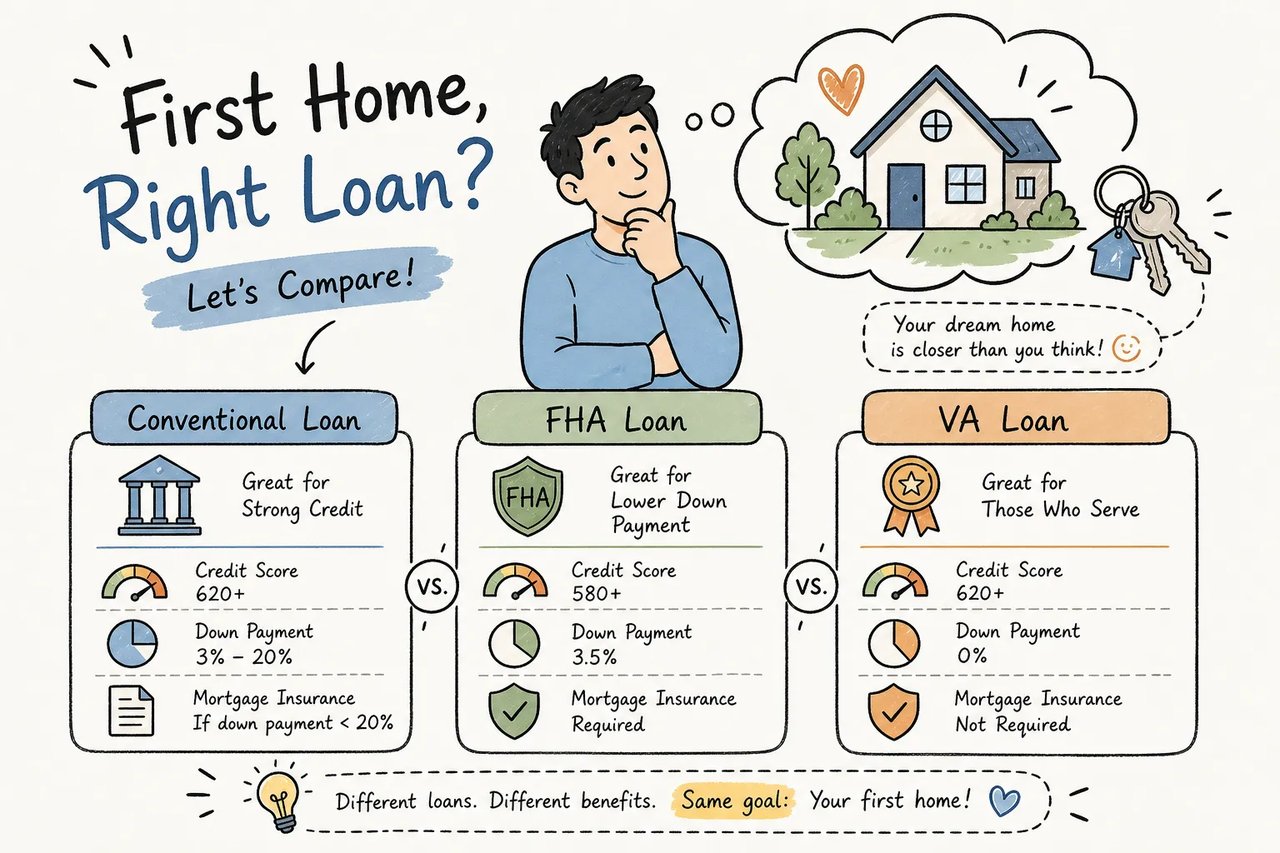
FHA loans set a federal floor of 580 for the standard 3.5% down payment path. Scores between 500 and 579 still technically qualify under FHA guidelines, but the required down payment jumps to 10%. Conventional loans don't have a federal backing mechanism to create exceptions below a 620 score, which means 620 is the practical floor with no workaround through standard channels. These two options cover the majority of first-time buyers who don't have military service history.
VA and USDA loans have no federal credit score minimum, but that doesn't mean lenders approve any score. VA lenders typically require 620 to 640, with 640 often needed to pass automated underwriting. USDA lenders generally expect scores in the low 600s. The absence of a federal floor is not the same as easy approval; lenders fill that gap with their own internal requirements.
Here's something many buyers don't know: even when a program's guidelines technically allow a lower score, individual lenders apply overlays, internal minimums that exceed the program's published floor. A buyer with a 560 score may technically sit within FHA's range but get turned away by most lenders in practice. The published minimum and the realistic minimum are two different numbers. Understanding that distinction is part of why working with someone who knows the local lending options matters before you start making offers.
FTHB loan requirements: down payment sources and minimums
VA and USDA loans both allow 0% down for eligible borrowers. FHA requires 3.5% for borrowers at 580 or above. Conventional loans can go as low as 3% through the Conventional 97 program, though 5% to 20% is more common in practice. Buyers who put less than 20% down on a conventional loan will pay private mortgage insurance until their equity crosses that threshold. In 2026, PMI on a conventional loan with 3% down typically runs between 0.58% and 1.71% annually depending on credit score, which on a $350,000 loan means roughly $169 to $500 added to your monthly payment.
Sources of funds: what each loan type accepts
Down payments don't have to come entirely from personal savings. FHA allows gift funds from family members, employers, nonprofits, and government down payment assistance programs, as long as those funds are documented as non-repayable gifts. Conventional loans follow similar rules. VA allows seller contributions of up to 4% of the loan amount toward closing costs. USDA accepts gift funds combined with assistance programs as well. The key requirement across all loan types is documentation: where the money came from must be verifiable and clean.
WSHFC Home Advantage: a Snohomish County-specific option
Washington State's WSHFC Home Advantage program is worth knowing about specifically. It offers second mortgages and grants for first-time buyers to cover part of the down payment, with a statewide income limit of $215,000 and a purchase price cap of $850,000 in Snohomish County for 2026. These programs layer on top of the base loan rather than replacing it. If you're buying in Snohomish County and haven't looked into this program, you may be leaving money on the table.
Debt-to-income ratio limits and how lenders actually evaluate them
Lenders use your debt-to-income ratio, the share of your gross monthly income consumed by all monthly debt obligations, to assess whether you can handle a mortgage payment on top of existing debts. The widely referenced ceiling is 43%, but that number is not a hard stop across all loan types. FHA allows DTI up to 55% when automated underwriting approves the file. Conventional loans backed by Fannie Mae can approve DTIs up to 50% through Desktop Underwriter. USDA carries similar flexibility in strong files.
VA loans work differently. There's no fixed DTI cap. Instead, the VA uses a residual income standard: what's left over each month after all obligations, taxes, and estimated living expenses are paid. In Washington State, a family of four needs at least $1,117 in monthly residual income to qualify, and that threshold rises if your DTI exceeds 41%. A borrower can have a DTI that exceeds the guideline and still be approved if residual income is strong. A borrower with a low DTI can still be declined if residual income falls short. It's a cash-flow test, not a ratio test.
Automated underwriting systems evaluate the full loan file as a whole rather than filtering on any single metric. A buyer with a 720 credit score, six months of cash reserves, and a DTI of 50% may get automated approval where a manual review would not. Lenders can also impose internal overlays that cap DTI below what the system would otherwise permit, so results genuinely vary by lender, another reason why knowledgeable local guidance pays off before you're deep into the process.
Documents every lender will ask for
Salaried employees should expect to provide W-2 forms for the past two years and pay stubs covering the most recent 30 to 60 days. Self-employed borrowers need two years of signed federal tax returns with all schedules, plus a year-to-date profit and loss statement. If any of your income comes from supplemental sources like Social Security, child support, or alimony, you'll need award letters or court orders to document those amounts.
On the asset side, lenders want bank statements for all checking, savings, and investment accounts covering the last two to three months. Retirement accounts like a 401(k) or IRA are often requested as well. A valid government-issued photo ID and your Social Security number are required for credit verification. Once you're under contract, the signed purchase agreement gets added to the file. If any portion of your down payment is a gift, you'll need a signed gift letter from the donor stating the funds are not a loan.
Getting these documents organized before your first lender conversation shortens the pre-approval timeline significantly. In a multiple-offer situation, a pre-approval packet that arrives complete and organized on day one signals to listing agents that the buyer is ready to close, and that signal carries real weight.
Matching the right loan to your actual situation
Each loan type serves a distinct borrower profile. VA is a strong option for eligible veterans and active-duty service members. It requires no down payment, no private mortgage insurance, and offers flexible DTI evaluation through the residual income framework that can work in a borrower's favor. USDA works for buyers targeting eligible rural areas in Snohomish County, including communities like Sultan, Stanwood, Granite Falls, and rural pockets around Snohomish, who also meet income limits. It's a zero-down option that most buyers in the area overlook entirely.
FHA suits buyers with credit scores in the 580 to 619 range or limited savings who need the lower down payment threshold. Conventional becomes the most cost-effective path once a buyer has a 620 or higher credit score and at least 3 to 5% saved, particularly because mortgage insurance on a conventional loan can be dropped once equity reaches 20%. FHA's mortgage insurance premium, by contrast, may remain for the life of the loan depending on the down payment amount.
Knowing which loan fits your profile changes how you search, what price range makes sense, and how sellers perceive your offer. At Pilchard Properties, we work with first-time buyers across Snohomish County to connect their credit profile and savings to the right loan type before they start touring homes. If you're thinking about buying in Everett, Edmonds, Snohomish, or anywhere else in the county, reach out before you start your search. The conversation costs nothing and can save you months.
FTHB loan requirements in Snohomish County: frequently asked questions
What credit score do I need to buy my first home?
It depends on the loan type. FHA loans require a minimum score of 580 for the 3.5% down payment option. Conventional loans require at least 620. VA and USDA loans have no federal minimum, but most lenders apply internal requirements starting around 620 to 640. Individual lender overlays can raise these floors further, so it's worth confirming requirements directly with your lender.
What are the down payment requirements for first-time buyers?
VA and USDA loans allow 0% down for eligible borrowers. FHA requires 3.5% with a 580+ credit score. Conventional loans start at 3% through the Conventional 97 program. Washington State's WSHFC Home Advantage program can help cover part of the down payment through grants or second mortgages for buyers who qualify.
Do FTHB loan requirements differ for self-employed buyers?
The core eligibility thresholds, credit score, DTI, down payment, apply equally. Where self-employed buyers face additional scrutiny is in income documentation. Expect to provide two years of signed federal tax returns with all schedules and a year-to-date profit and loss statement. Lenders calculate qualifying income from your net figures after deductions, which can reduce the income number used for DTI purposes.
What FTHB loan requirements apply in Snohomish County specifically?
Federal loan requirements (FHA, VA, USDA, conventional) apply statewide. Local factors include WSHFC Home Advantage income and purchase price limits, in Snohomish County, the 2026 purchase price cap is $850,000, and which rural communities qualify for USDA eligibility. A local agent familiar with these programs can help you identify which options apply to your target area.
Getting pre-approved is the actual first step
First-time homebuyer loan requirements are specific, navigable, and far less intimidating once you see them broken down by loan type. Credit score floors, DTI flexibility, zero-down eligibility, down payment sources, required documents: each of these has clear answers that depend on which program fits your situation. The complexity isn't in the rules themselves. It's in knowing which rules apply to you.
The most practical move you can make right now is not finding a house you love. It's getting pre-approved. Pre-approval tells you what you can actually offer, which loan type fits your file, and whether there are any gaps to address before you're competing against other buyers. Working with a local agent who understands both the FTHB loan requirements relevant to your situation and the Snohomish County market makes that process faster and less stressful. Get pre-approved first. Then search with confidence.